Why UL Panels Matter for Exporters
t
SPONSORED
For any manufacturer exporting electrical panels to the US or Canada, UL certification is the line between a sellable product and one that gets stopped at the border. North American jurisdictions require it, procurement teams treat it as a baseline condition, and inspectors enforce it on site. Two standards do most of the work: UL 508A for industrial control panels and UL 891 for low-voltage switchboards. Understanding what they require — and getting them in place before the first shipment — is what keeps an export project on schedule.
The cost of non-compliance
The risk starts long before a panel is switched on. When an exporter ships equipment without the right certification, the problem surfaces at the worst possible moment: on site, in front of an inspector who can stop the whole installation. Manufacturers like Systemteknik build their process around avoiding exactly that outcome.
Rejection is rarely a single event. A blocked installation delays commissioning, which pushes back the handover date, which can trigger penalty clauses or void the contract entirely.
Procurement teams across North America treat UL certification as a baseline condition. If the paperwork does not hold up, the shipment gets rejected at the border or flagged during inspection. The exporter then carries the cost of rework, re-shipping, and lost time plus liability exposure if an uncertified panel fails.
How UL certification opens the North American market
UL certification is what turns a well-built panel into a sellable one across the USA and Canada. Without it, the panel cannot be legally installed in most jurisdictions. With it, the exporter gains contract eligibility, legal installation rights, and faster approvals.
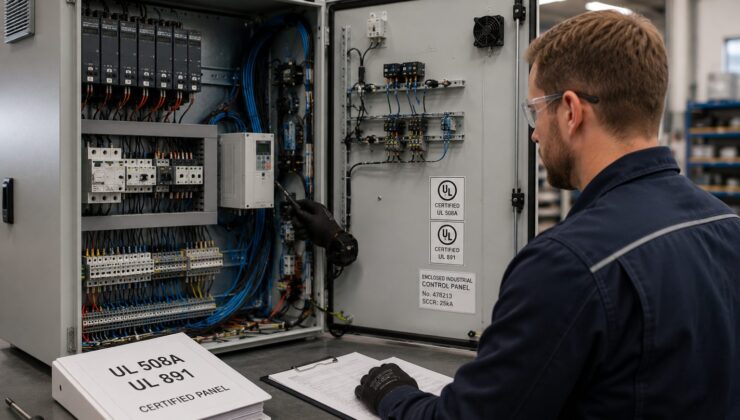
UL 508A is the standard for industrial control panels and the one exporters ask for most often. It covers wiring and spacing requirements, component placement, electrical safety testing, and labelling documenting the whole system, not just one component.
UL 891 covers low-voltage switchboards up to 600V. It is less commonly requested than UL 508A, mostly because control panels tend to be more complex.
These are not optional quality marks. For control panels going to North America, UL certification is written into contracts and enforced by local inspectors. Skipping it just moves the cost to a later, more expensive stage.
Three questions to ask any panel supplier
• Does the supplier hold both UL 508A and UL 891, or only one? A supplier with both can cover control panels and switchboards inside the same project.
• Do they provide full compliance documentation and UL labelling as part of the build? Certification without the paperwork attached to each panel is worth very little at inspection.
• Do they have verified experience delivering panels for complex export projects? An experienced supplier has already solved the problems you are about to encounter.
The cheapest quote often turns out to be the one missing one of these three — and that gap is where delays and rejections come from.
What dual UL certification means in practice
Holding both standards changes how a project runs. A manufacturer certified for UL 508A and UL 891 covers a broader slice of export requirements within a single build, so you do not have to split production across multiple vendors and stitch documentation together at the end.
Systemteknik's UL panels are built to meet both UL 508A and UL 891 from the design stage. The company also holds ISO 9001 and ISO 14001, documenting the managed process behind every build not just a one-off audit pass.
Experience matters more than certification alone
Certification is necessary. It is not sufficient.
Systemteknik's 70-plus years of panel-building covers some of the most exacting environments in the industry, with service capability running from design through installation, commissioning, and maintenance. Certified panels tend to matter most in:
• Data centres, where reliable data collection depends on panels that never miss a beat
• Green energy installations, including wind farms and solar parks
• Power-to-x and energy distribution facilities
• Large industrial facilities with high uptime demands
These are the projects where certification that looks fine on paper but fails under real conditions costs the most. Experience is what closes that gap.
The bottom line for exporters
For exporters targeting North America, the choice of panel supplier is effectively a compliance decision. Working with a manufacturer that holds the right certifications, builds documentation into the process, and has the track record to back it up removes the risk before it ever reaches the jobsite.